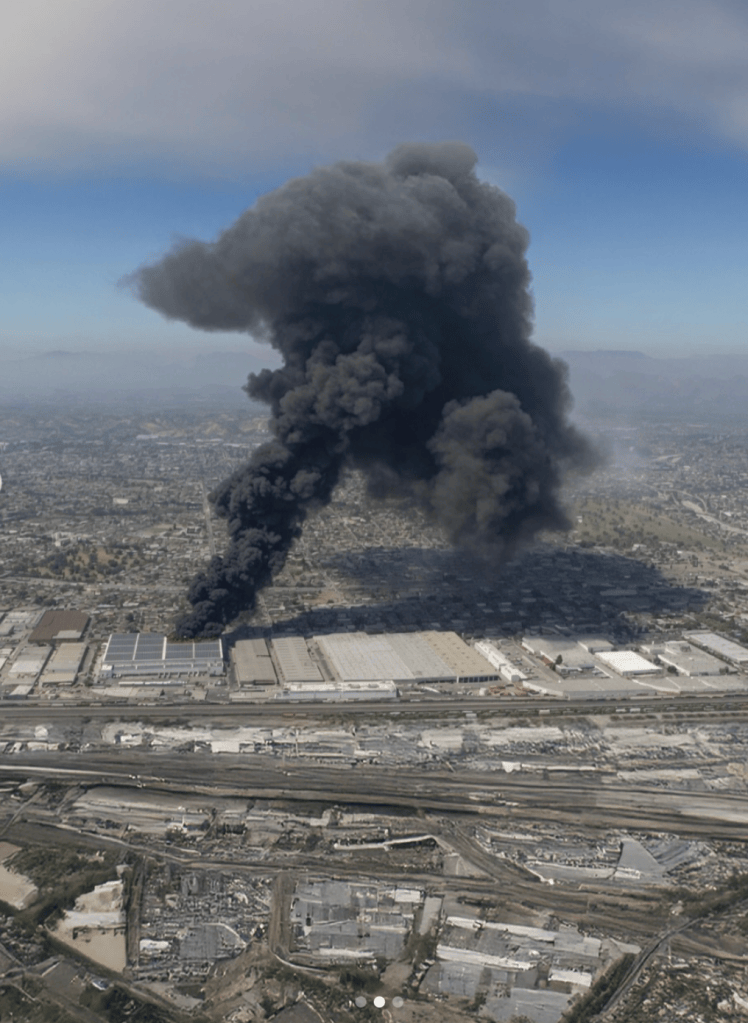
When my friend Jazmin Garcia texted me about the work her group Eastside Padres Contra La Privatización was doing in Boyle Heights, I knew it was intense. She and her fellow grassroots activists were on the scene early, knocking on doors and talking to the neighbors of Lineage Logistics. This is the cold-storage warehouse where a fire broke out on June 17, when subcontractors were working on the rooftop solar array. The cause remains under investigation. The smoke and hazardous air spread across large swaths of greater Los Angeles, but the fallout was especially brutal in East L.A. When Jazmin asked if I wanted to join them as they canvassed the neighborhood, I said yes.
What I saw was mind-bogglingly awful. And at the same time, not shocking.
Jazmin said to meet her at the corner of La Puerta and Olympic which pricked my historical psyche because I know that Olympic is the border of the original boundary of Pueblo de Los Angeles as laid out by one of the early power brokers, the Spanish Crown. Spain began colonizing the Americas at the end of the 15th century and after a couple of centuries tearing through thriving communities of Mexico (and South America), soldiers and the church marched north until finally, in 1781, Governor Felipe de Neve established the Pueblo de Los Angeles near the river as part of Spain’s colonization of Alta California. Under Spanish rules governing pueblos, Los Angeles was allotted four square leagues, laid out on a 45-degree angle. Some sources say the angle had something to do with climate and an even distribution of sun. I’m unclear; I just know that later it all got straightened out at Hoover where we all take a turn on westbound streets. The southeast corner of that original pueblo boundary is at modern-day Indiana Street and Olympic Boulevard in Boyle Heights. I knew in my bones that Lineage being situated outside of the original pueblo meant this neighborhood had a different historical DNA than the community north of Olympic. I double-checked a Thomas Guide that I still have on my bookshelf and saw the dashed line: Rancho San Antonio. I was confident that would have significance but first I needed to meet Jazmin.
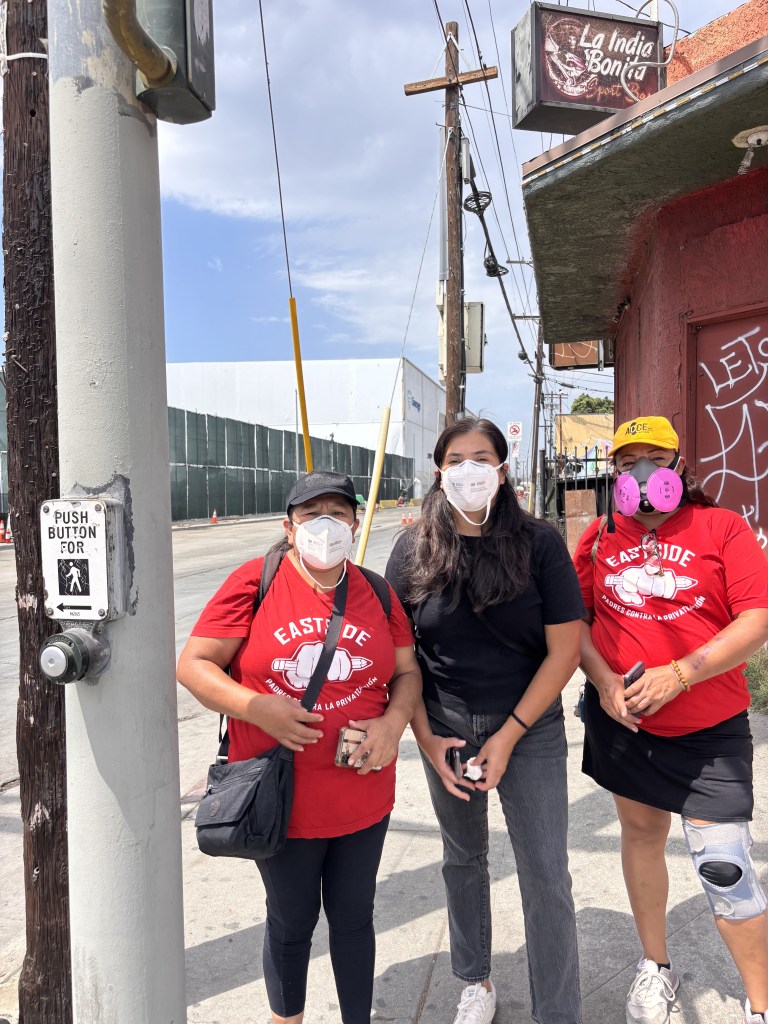
I was grateful the weather was just hot and not super-hot, as it had been the prior week. It was in the high 80s when I found Jazmin, Eloisa Galindo and Tomasa Martinez on the east side of La Puerta. I have known Eastside Padres since the 2019 UTLA teachers strike, when I was a public-school parent and advocate. I remember one parent meeting where Eloisa called out an Eastside school board member for her long history with big-money privatizers, including charter schools. It was an exceptionally raw moment and left an impression on me: Eastside Padres does not take hostages when they do real work. Since then, I have followed their grassroots efforts, joined them at protests and press conferences and try to stay current with their many righteous fights.
Now, on this sunny August day, I wanted to see this neighborhood through their work. After quick hugs, Jazmin asked, “Do you have a mask?”
I pulled one from my purse. She frowned.
“Take this one.”
She handed me an industrial mask. As I pulled it snug over my nose and mouth, I felt like a kid on a ride at a theme park when the attendant tightens the seat belt before the speed and bumps hit.
The first thing I noticed was the age of the houses: A mixture of mid-century homes, 1920s bungalows and pre–WWI Craftsmen, some with their original bones exposed and others covered in stucco. The houses looked like the kind of working-class housing that grew up around industrial and railroad districts all over Los Angeles. Some porches were enclosed, some yards paved over for additional parking, but there was still a bit of nature, a fruit tree or a flower garden, often well-tended. It may be an older working-class neighborhood, but it is not in disrepair.
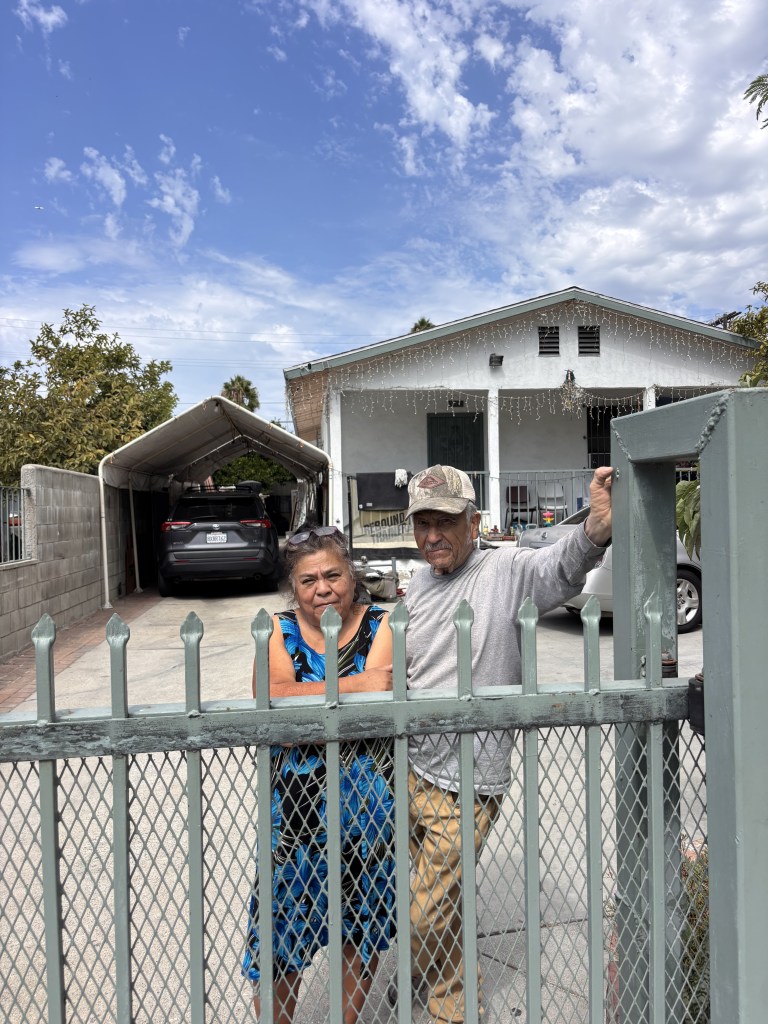
Eloisa and Tomasa walking ahead, called to us. They wanted to talk to an older man watering a tree in his yard. We joined them and the conversation was in Spanish as Jazmin asked his name and explained who they were.
Guillermo nodded. I heard many “sí,” and Jazmin explained that he remembered Eastside Padres from a press conference they had held on this block earlier in the month. Guillermo added that he had joined them.
I asked if this kind of engagement was new for him. He said that when he was a student in Mexico, he did more political stuff. His face was deeply lined and tanned, and something about his smile made me ask, “How old are you?”
He answered in Spanish. Even with my limited Spanish, I knew what he’d said when Jazmin translated: “68.”
“Me, too,” I said.
We both smiled.
Guillermo and his wife Angelita live in a house built in 1914, (according to Zillow), with their multigenerational family. Eight people under one roof. On June 17, when the Lineage fire broke out, Guillermo and Angelita were home with their grandchildren.
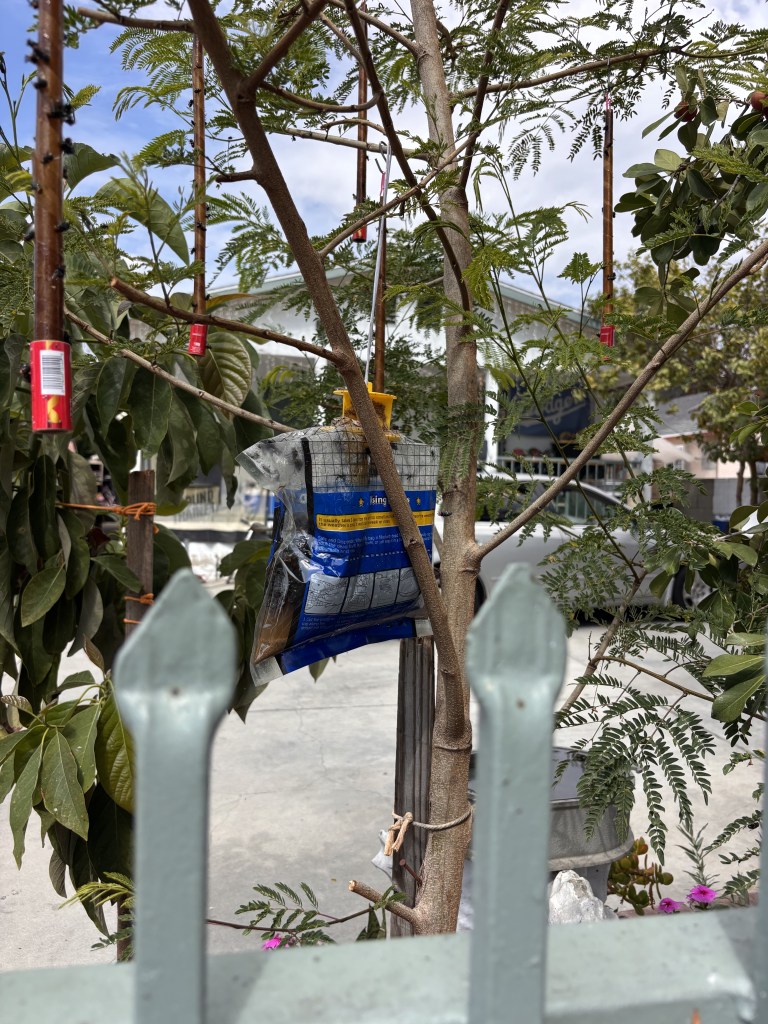
Eloisa pointed to a bag hanging from a tree on the sidewalk. It was full of flies. I had already felt bites on my legs. Now I understood why. Flies were everywhere.
Another small bag hung from the young tree Guillermo was watering, which looked like an avocado. I asked about the bags. No one seemed to know who had put the trap on the tree by the sidewalk. But the one hanging from Guillermo’s tree was his. It was already halfway full of dead flies.
“When did you put it up?”
“This morning.”
I looked at Eloisa and Jazmin. My face must have registered shock. They gave me a sad nod in return. A bag half-full of dead flies before 10 a.m. was not a new concept to them. Not since this mess with Lineage started in June.
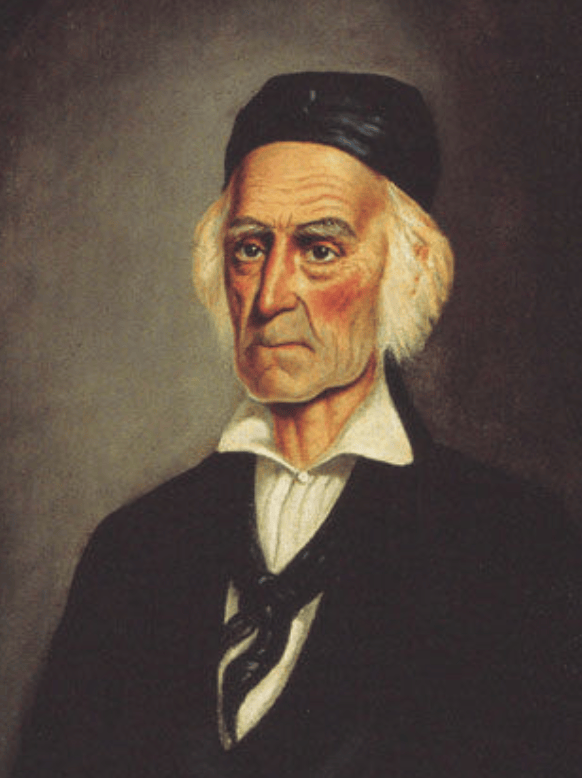
In 1810, after seventeen years as a Spanish soldier, Antonio María Lugo moved his wife and four small children from the Santa Barbara Presidio to Los Angeles. The journey south would have taken several days, perhaps three, traveling on horseback and with pack animals. Lugo already knew the area. Before 1810, he had begun raising horses and cattle near the river in Los Angeles.
That same year, Spanish Governor José Darío Argüello granted Lugo land for what would become Rancho San Antonio. The land would survive governments even as its paperwork changed with them. Lugo established his rancho headquarters near what is now Bell Gardens, where his adobe still stands.
Lugo was not arriving in an empty landscape. His father, Francisco Salvador Lugo, had been sent to guard livestock at Mission San Gabriel after complaints that local Indigenous people were taking mission cattle. By 1810, the violence, coercion and dispossession experienced by Indigenous people under the Spanish mission and military system were already well established. Even the word “stolen” becomes complicated when the livestock and the people guarding it, had been introduced onto land Indigenous communities had occupied for generations.
Back then, the environment itself was also different. The Los Angeles River of 1810 did not follow the course we know today. South of the pueblo, it turned west, eventually reaching the sea through the Ballona drainage near present-day Marina del Rey. A major flood in 1825 changed that geography, sending the river south toward San Pedro and through the western portion of Rancho San Antonio. Lugo had established his home near the Rio Hondo, which in 1810 was a more dependable source of water in an arid landscape.
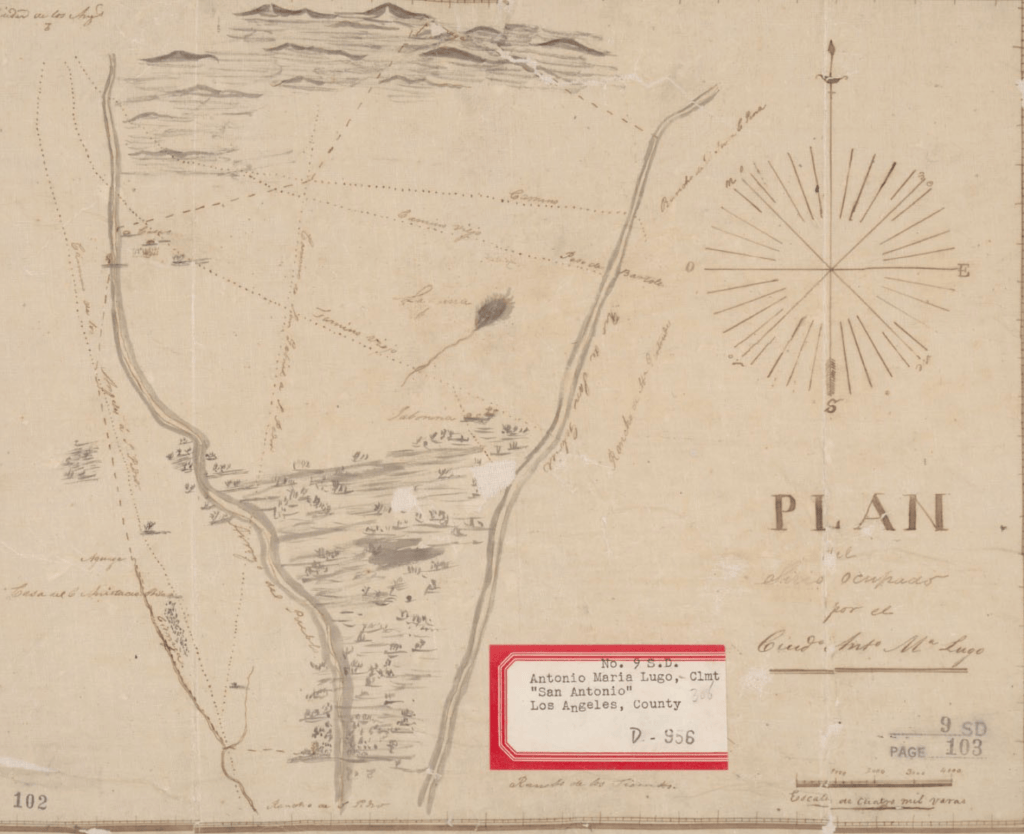
Rancho San Antonio would survive three governments. Lugo received the land under Spain; Mexico confirmed and expanded his claim; and after California became part of the United States, the rancho survived the American land-claims process. In 1866, six years after Lugo’s death, the United States issued the patent of roughly 30,000 acres stretching from the Rio Hondo country toward the southern boundary of the old Pueblo of Los Angeles.
For decades, cattle moved across that landscape. Hides and tallow had long been important products of California’s cattle economy, and the Gold Rush created enormous new demand for beef as San Francisco’s population exploded after 1849. Cattle grazed across Rancho San Antonio, including its northern reaches—the ground where, nearly two centuries later, rotting meat and processed food inside Lineage would become a nightmare for Guillermo and his neighbors.
Jazmin, Eloisa, Tomasa and I continued down the block toward Lineage. They pointed out traps along the street. The rotting food inside the warehouse had created another problem: Rats.
By late July, the Los Angeles Times reported that rat traps were stationed about every ten feet along Union Pacific Avenue to catch hungry rodents drawn to the millions of pounds of decomposing meat inside the warehouse. “They’re giant rats,” one neighbor told the paper. And this wasn’t just neighborhood lore. When Los Angeles County Public Health surveyed households around Lineage, 35 percent reported an increase in rodents and 76 percent an increase in flies.
Now I had one eye out for rats as we walked.
Soon, the statistics became considerably less abstract. Jazmin asked Tomasa if she had a wipe. She had just swatted a fly that was biting her arm. “I need to get the green fly guts off my skin,” she said.
Behind a temporary fence covered with mesh netting, we could see workers moving around what remained of Lineage. Before the fire, the cold-storage warehouse had sprawled across roughly 490,000 square feet, most of it just one story. A massive horizontal building pressed against this little neighborhood. The fire had burned for about a week. Now demolition and cleanup were underway.
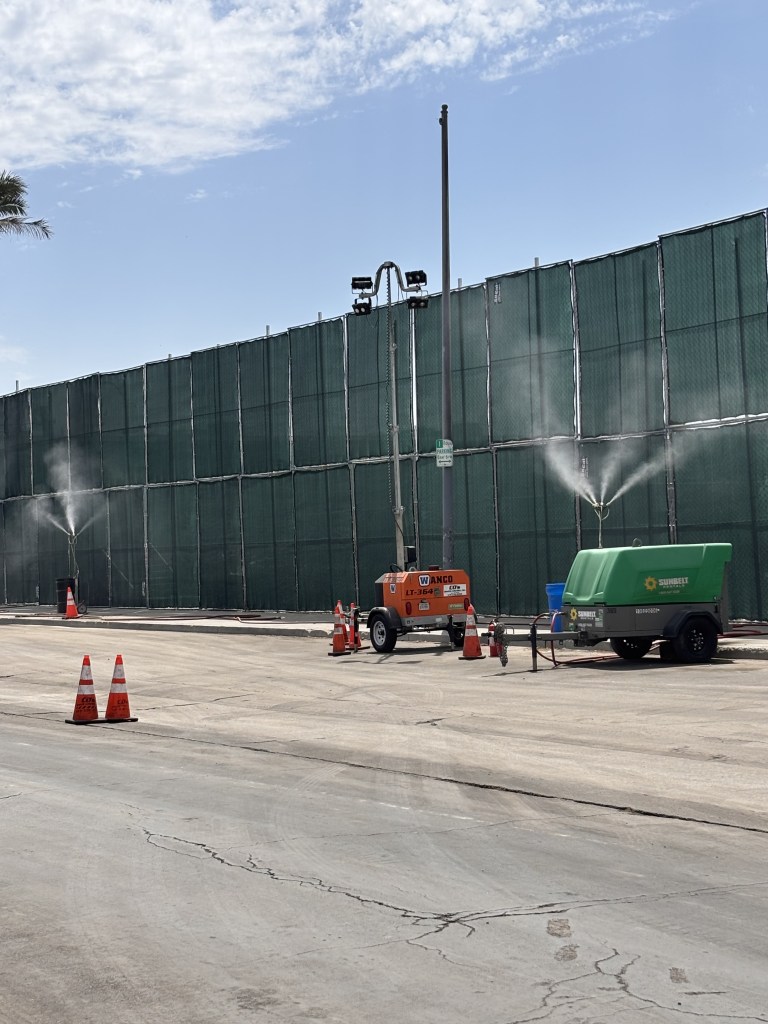
I noticed the smell was a mixture of something gross and something chemical. I asked the gals what I was smelling and Eloisa pointed. Four large sprayers, each about six feet tall, were shooting a liquid mist into the air. The zzzsting sound was familiar. If you closed your eyes, you might think you were at a fancy golf course with commercial sprinklers cooling bright green lawns instead of standing across from a burned-out cold-storage warehouse spraying air freshener.
“No one knows what is in the chemicals,” Tomasa said.
“Neighbors keep asking and all they are told is, ‘It is safe,’” Jazmin said.
“Do they believe it?” I asked.
All three Eastside Padres shook their heads.
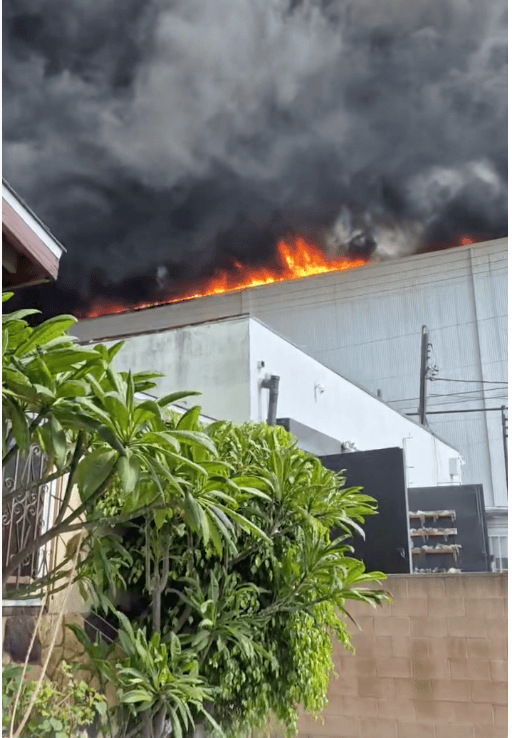
We next went to the house closest to Lineage. It had a front yard with grass and a garden where real plants and flowers mixed with artificial ones. Jazmin sent a text and a minute later Tere Pedroza, a woman in a bright colored sleeveless shirt and jeans, came outside. She was happy to see the ladies. While they talked, I looked across at Lineage and estimated it was about 100 feet from Tere’s front porch.
Terry loves gardening. She told us how much joy she gets from working in her yard, but since the fire she had been forced to cut back most of her flowering bushes in her garden because the blossoms were attracting even more flies. She’s heartbroken.
“It has made me very sad,” she said
I asked her what it meant to be Ground Zero to Lineage.
Tere explained that she was home when the fire broke out. She went into her kitchen, which has a skylight, and looked up. The sky was black.
“It felt like an eclipse.”
She ran outside and saw flames on the roof.
“It started at that corner,” she said, pointing toward the northwest corner of what was now the empty lot. “By the time the fire department got there, the fire was all the way to the Indiana corner. I watched it all.”
Tere estimated the fire department arrived about ten minutes after she first saw the flames.
She and her family stayed in their house through the fire and the cleanup. She would have liked to leave, but they have no family in Los Angeles. Jazmin asked her a question in Spanish and translated the answer for me: “They were told it was safe to be there by officials. Then the fire department said it might explode and told us to go to a park. They went there for a couple of hours and then just came home.”
As we left Tere’s house, Jazmin pointed toward the cleanup site. Birds, crows, I think, were circling overhead and diving toward something on the other side of the mesh fence. At the time of our canvass, Lineage said the cleanup was about 90 percent complete. Tere, Tomasa and Eloisa were skeptical. They said the other building on the property was nowhere near cleaned out.
By the end of the week, Lineage acknowledged it would not meet its 45-day deadline to complete the cleanup.
I thought of the birds.
Earlier, we had talked with Guillermo and his wife Angelita, about when the old Continental Can factory came down and the much larger cold-storage warehouse went up. Angelita said no one told the community what was coming.
“My neighbor wanted to build a second story on his house, and he had to get all the neighbors to sign a paper,” she said. “These people come in, no one knows anything and they just build it.”
Guillermo remembered construction going on at all hours of the day and night. When some of the neighbors complained about the noise, he said, the company brought them a bag of beans and a bag of sugar.
“And a ham,” Angelita added.
The husband and wife squabbled for a moment, trying to remember whether the ham came first or last.
I asked when this happened. They thought it was around 2018.
To me, it felt like something a company would have done in 1918.
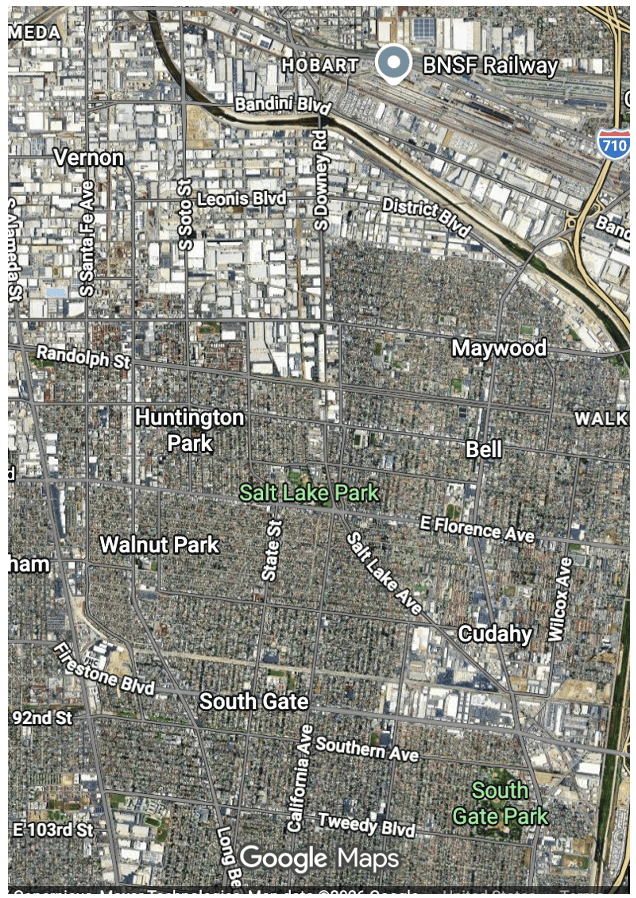
There is an uneasy relationship when you live in a neighborhood surrounded by industry. How and when that relationship began in this case becomes visible when the old boundary of Rancho San Antonio is laid over a modern aerial image. In the northern portion of the rancho, around Vernon, the railroad yards and the land north of Maywood, the small roofs of houses abruptly give way to enormous industrial buildings. Farther south, through Bell, Cudahy and South Gate, the landscape is predominantly residential.
From hundreds of miles above, Rancho San Antonio has an unmistakable line of demarcation.
That division was not created by a single decision. Antonio Lugo had begun dividing Rancho San Antonio among his children before his death in 1860. Over the following decades, portions changed hands repeatedly as the Lugo family’s cattle empire gave way to American real-estate ownership, agriculture, dairies, subdivision and eventually industry.
Abel Stearns, a Massachusetts-born merchant, became one of the great landholders of Southern California. In 1841, when he was forty-three, he married fourteen-year-old Arcadia Bandini. Why that creepy 30-year age difference was okay is beyond me but with it, Stearns became Californio-adjacent. Through Stearns and later Arcadia, portions of the former Lugo landscape became associated with Rancho Laguna, a cut out of San Antonio.
Stearns died in 1871, but Arcadia lived another forty-one years, long enough to see railroads and land speculation transform what the old rancho landscape would become. After her death in 1912, a syndicate purchased 2,700 acres of Laguna Rancho property and formed the Laguna Land and Water Company.
The transformation happened unevenly. Farmland and dairies gave way to subdivisions. To the south, Huntington Park, Bell, Maywood and communities farther down became increasingly residential as Los Angeles grew. To the north, proximity to the rail lines made former rancho acreage increasingly valuable for factories, freight and industry.
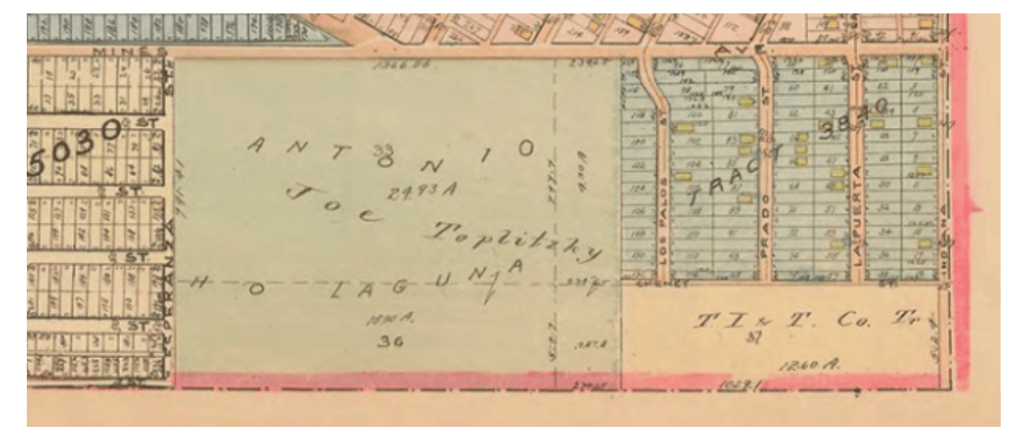
And then there is the 1921 Baist map.
I love this map because it catches the transformation in progress. The residential lots along La Puerta that I had just walked with Eastside Padres are already there. Immediately beside them are much larger acreage parcels. One, owned by Joe Toplitzky, has the words RANCHO LAGUNA stretched across its 21.93 acres. Beside it sits a 12.40-acre parcel identified as T.I.&T. Co., Trustee. That parcel would become the Continental Can in 1928.
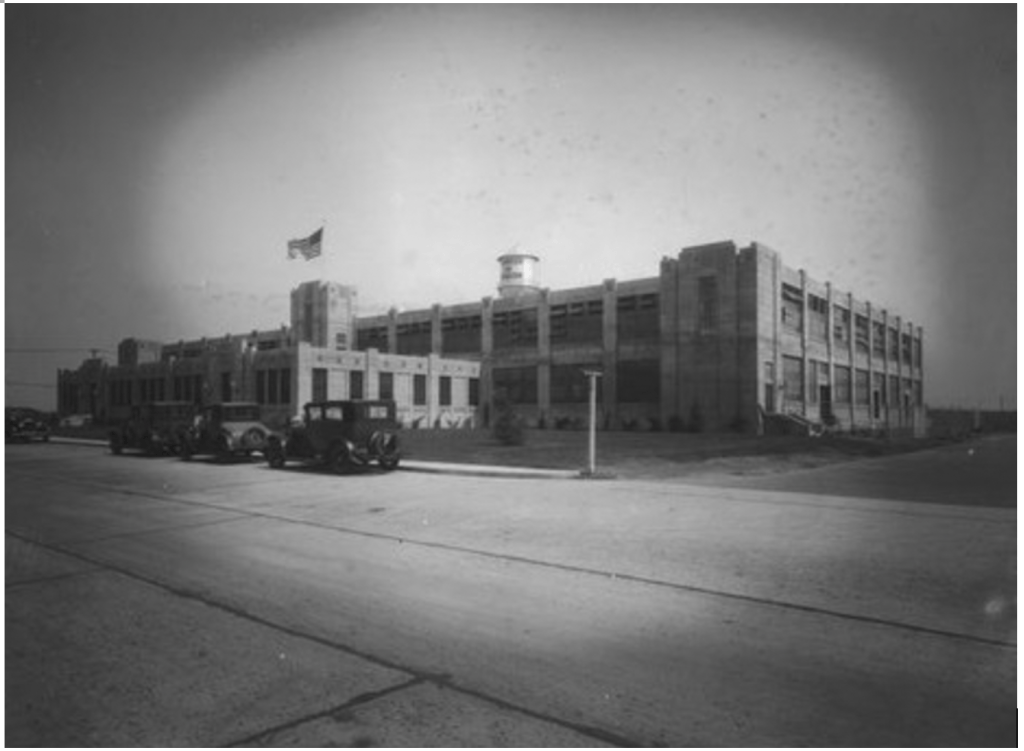
The City of Los Angeles would later describe the can factory as “a remarkable example of the Art Deco style with Moderne style influences as applied to an industrial property,” noting that its relationship to the railroad made it representative of “Transportation Improvements and Industrial Growth in Boyle Heights.”
When Guillermo and Angelita bought their house about twenty years ago, the factory had already lived several lives. It had stopped manufacturing cans in 1983. By 1996, federal records place Pillowtex Corporation, a manufacturer of household furnishings, at the old Continental Can address, and Pillowtex was still operating there in 2000. Through all of this, the original 1928 factory survived. When Los Angeles surveyed it as a historic resource in 2007, the city found that it retained a high level of physical integrity.
Having a large aging industrial site in a neighborhood raises a complicated, ticking-time-bomb question: What will come next?
A decade later, everything changed. Plans for a new freezer warehouse were underway in 2017, followed by construction of a cold-storage facility through 2017 and 2018. Guillermo and Angelita remember the demolition and construction happening around them in 2018, at all hours.
Eventually, the enormous cold-storage operation became the Lineage facility. Clearly, Lineage would prove to be an extra-dramatic neighbor.
If there was one theme I saw in the canvassing, it was a lack of trust that anyone in power would do the right thing.
Norma, a homeowner across from Tere, was at work when the fire broke out, as was her husband. She could see the smoke from downtown at her job, and the two texted each other.
“We were scared and it brought back the fires.”
Eloisa nodded. Jazmin said, “There is a PTSD from the Altadena fire. We all lived that smoke.”
When I asked Norma about leadership, she said she had received air filters from the city, and an air conditioner from “someone.” She didn’t know who.
“It’s been so hot, I have it running all the time and I am scared of my electric bill.”
That distrust extended even to the help being offered. Some neighbors spoke of $1,000 gift cards from Lineage. One family said they would not use theirs because they feared doing so could somehow be leveraged against them in any future legal action.
Jazmin told me about an earlier canvass when she and other Eastside Padres were walking the neighborhood and noticed three men working the same street: A white man and two young Latino men. When Jazmin spoke with one of the neighbors that the men had visited, the woman said she had been given a card and asked to sign something.
Jazmin asked what she had signed. The woman said she didn’t understand it and wanted to know.
Jazmin went looking for the three men. The white man was wearing a shirt with the word Lineage” in very small lettering. The two young men were bilingual in shirts with a Pentecostal church logo.
“I confronted the man and said, ‘What are you telling these people when they sign your paperwork? Because they do not know. And why doesn’t your shirt say Lineage in bigger lettering so they can read it and know who you represent?’”
“The man got angry” Jazmin continued, “You can be disrespectful if you want and I can do it back, but you know what you are doing is wrong.”
Like I said Eastside Padres have got game.
Another man told us his family had moved into an Airbnb paid for by Lineage. He didn’t know whether they had signed anything that might affect their ability to sue by accepting the offer.
During the canvass, everyone was asked what they would like to see in place of Lineage.
No one I heard said they wanted it to return.
Multiple people wanted a park, especially given how little green space there is in the neighborhood outside of the nearby cemetery. Others wanted affordable housing or a community center.
Eastside Padres has requested a meeting with Mayor Bass’s office. A few days after I walked the neighborhood, the Padres met with Councilmember Jurado’s office. I circled back with Jazmin to find out how it went. Jazmin said they brought a few neighbors including Tere, “She expressed how she is depressed by it all and she now has tiny flies in her tap water.” I thought how a bad situation has gotten worse.
Jazmin, “We also brought a grandma who used to take care of her grandkids every week and now she has not seen them in weeks because their parents don’t think her house is safe. She is lonely.”
I asked, “What was the response by the councilmember?”
“She heard the neighbors. She talked about the (Bass) motion to pause the rebuilding, but that’s not enough for us.”
“I mean, it’s a huge disaster. We’re not like the nonprofits that are just going to applaud recovery efforts. We expect Lineage to pay for the damage they have caused our community. Accountability means closure. Karen Bass’ pause is not enough.”
“You don’t trust it?” I asked.
“No. How do we know she’s not just trying to get through the election?”
I asked about the other mayoral candidate, Nithya Raman.
“We invited Nithya and she walked the neighborhood with us. She was humble. She asked questions. She wanted to hear what the neighbors are experiencing.”
She added, “There were no cameras. She was listening.”
After two hours walking the neighborhood, getting bitten by flies, looking out for rats and inhaling chemicals, I said goodbye to Jazmin, Eloisa and Tomasa.
Jazmin was heading out to take her daughter to the mall to buy clothes for the first day of school. Eloisa gave me an Eastside Padres shirt, and we hugged.
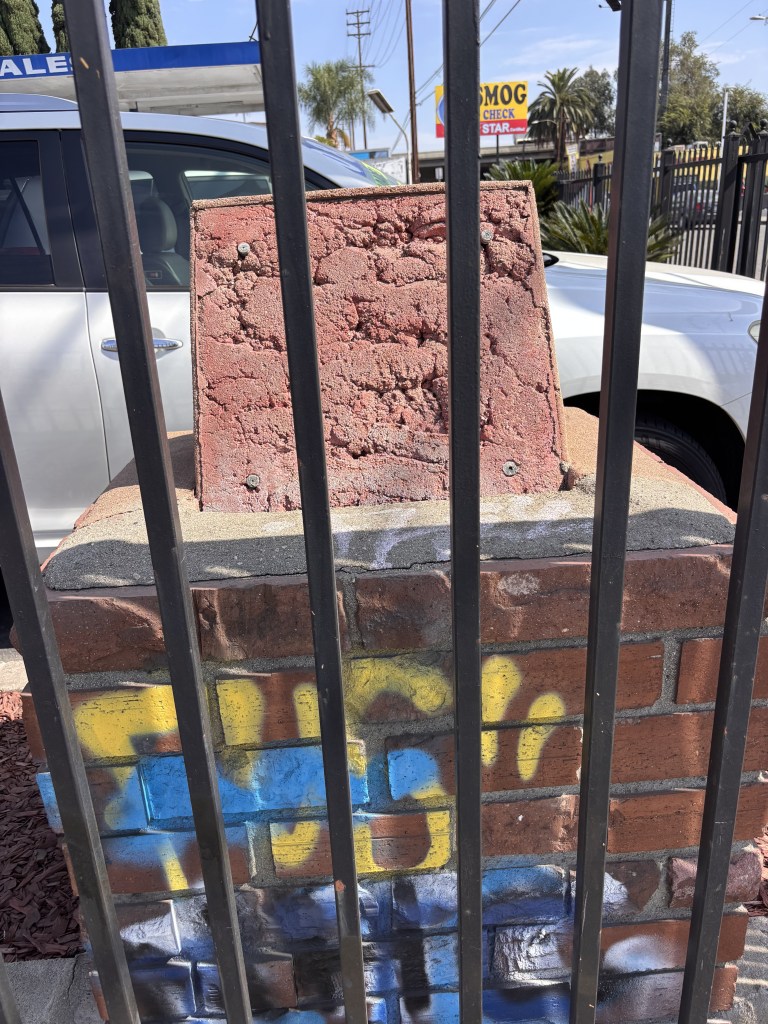
Just before I got in my car, I went to the corner of Indiana and Olympic and took a photo of the brick marker. The metal plaque was long gone; the bricks were tagged. This marks the southeast corner of the original Pueblo de Los Angeles boundary. It shares its space with an auto garage and a smog tune-up shop.
On my way home, I thought about a ham, bags of sugar and gift cards with strings attached. I was having a hard time separating Lineage from 18th-century Colonial New Spain. Then there was Rancho San Antonio and its cattle, and then the railroads and the 19th-century power brokers who did all they could to make money and celebrate industry in their drive to build Los Angeles, no matter what.
I wondered if the ghosts of long-dead cattle from Rancho San Antonio haunted Lineage.
When I got home, I showered for the second time and laundered my clothes because the smell of my day was on me.
It is also on our city.